By Ir. Lee Boon Chong
Chairman of Project Management Technical Division
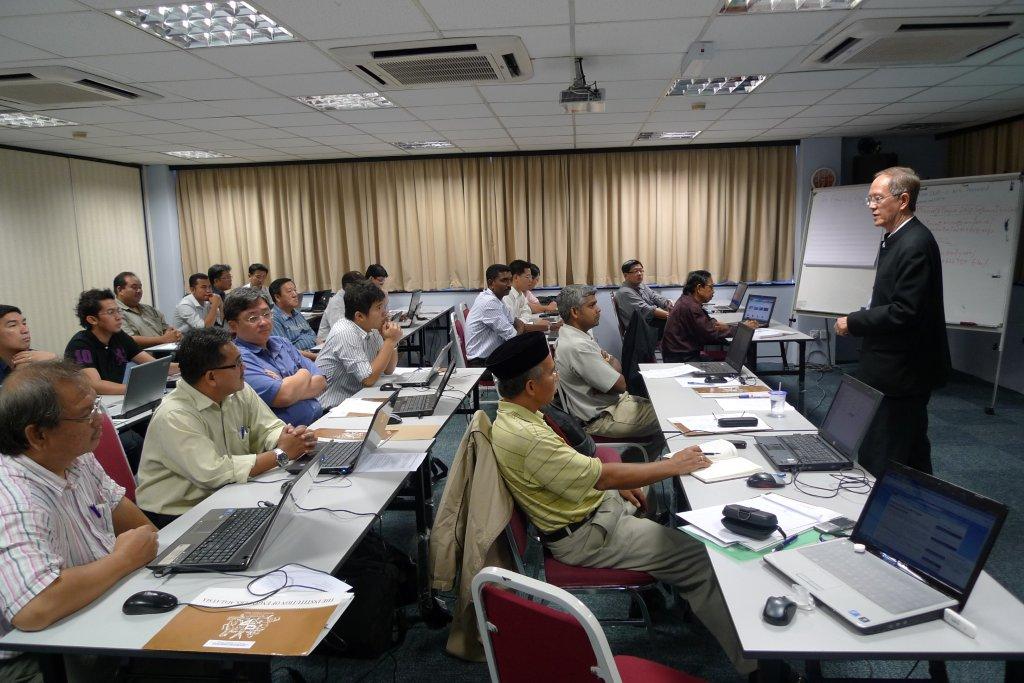
A 2-day course entitled “Essential Project Management”was organized by theProject Management Technical Division (PMTD) of IEM on 02-03 December 2010at Wisma IEM, Petaling Jaya. The course was conducted by Ir. Lee Boon Chong. A total of 44 participants consisting of both corporate members and graduate members of IEM from various industries attended the course.
Projects are employed as an important means of achieving organization’s business goals. Adopting a structured and integrated approach to project management is proven to be critical to the success of project as well as organization. The course contents were closely referenced to PMBOK Guide, 4th edition of the Project Management Institute (PMI).The course first covered the fundamental concept and framework as well as project business link before moving to the five project management process groups namely initiation, planning, execution, monitoring and controlling, and closing. A recapitulation is given below.
Fundamental Concepts and Framework
The section on fundamental concepts and framework is intended to provide the participants with basic context and foundation to understand the structured processes and detailed building blocks in subsequent sections. It covers the following:
- § Definition of project and project management.
- § Differentiation between project and operations.
- § Definition of programme management and portfolio management.
- § Definition, roles and configuration of project management office.
- § Project life-cycle, project management life-cycle and product life cycle.
- § Project constraints including triple constraints and hexagonal constraints.
- § Definition of project stakeholders.
Project Business Link
A project is normally conceptualized from the organization’s strategic or business viewpoint. It must be proven to be feasible as well as financially viable before start-up or initiation. This section covers the following:
- § Strategic business alignment of project.
- § Project business case.
- § Project feasibility.
- § Project investment appraisal–benefit-cost ratio, payback period, net present value, internal rate of return, return on investment etc.
- § Project brief and start-up decision.
Project Initiation and Mandate
Get the mandate and clear terms of reference. A project must first be initiated legitimately as only a proper mandate will give the project manager the authority to start up a project and commit organizational resources. This section covers the following:
- § Project start-up meeting.
- § Project statement of works.
- § Project charter and its development.
- § Project objectives and SMART criteria.
- § Project manager and sub-project manager – selection criteria and job functions.
- § Project management team and overall project team.
- § Influence of organisation structure – functional, project and matrix organisation.
- § Stakeholder identification, analysis and register.
Project Planning and Preparation
Plan the project work based on the project charter. This is done by establishing the total project scope, defining and refining project objectives, and developing the course of action required to attain the objectives. An integrated project management plan, together with the project documents is the single most important requisite that prepares for project execution and determines the success of project implementation. This section covers the following:
- § Project planning kick-off meeting.
- § Project management plan, together with the three performance baselines, the major component plans, as well as the integrative contents.
- § Project scope management planning and the related processes viz. collect requirements, define scope and create Work Breakdown Structure (WBS). Topics include project requirements documentation, project scope statement, project scope, product scope, decomposition, work package etc.
- § Project time management planning and its related processes viz. define activities, sequence activities, estimate activity resources, estimate activity durations and develop schedule. Topics include precedence and arrow diagramming methods, types of dependencies, resource requirement matrix, resource breakdown structure, PERT and three-point estimates, schedule reserve analysis, schedule network analysis, critical path method, types of floats, milestone chart, Gantt chart and schedule network diagram.
- § Project cost management planning and its related processes viz. estimate activity costs and determine project budget. Topics include life-cycle costs, types of estimates including PERT and three-point estimates, analogous estimates, parametric estimates, and bottom-up estimates, cost reserve analysis, budget reserve analysis, contingency reserves, and management reserves.
- § Project risk management planning and its related processes viz. plan risk management, identify risks, perform qualitative risk analysis, perform quantitative risk analysis and plan risk responses. Topics include types of risks, risk breakdown structure, risk register, risk trigger, risk score, probability and impact matrix, expected monetary value, risk response strategies, contingency plan and fall-back plan, residual risk, secondary risk, risk budget and risk reserves.
- § Project quality management planning – quality policy, quality recurring themes, quality management principles, cost of quality, control chart, process improvement plan, and quality management responsibilities.
- § Project human resource planning – project human resource roles and organisation, staffing management plan, responsibility assignment matrix etc.
- § Project communications planning – project information needs, project communications channels, barriers and enhancers, communications model, methods and forms.
- § Project procurement management planning–elements of contract, procurement role, make or buy analysis, types of contract, procurement statement of work, procurement documents, source selection criteria etc.
- § Summary of project management planning – integrated project plan.
Project Execution and Action
Execute the project plan. Project objectives, outputs and deliverables are obtained by performing and integrating the work defined in project management plan.This is done through obtaining, coordinating and managing people and other project resources. During project execution, a large portion of project budget is expended; and changes ensue, necessitating detailed analysis and appropriate responses like planning updates and baseline modification. This section covers the following:
- § Directing and managing project execution– work authorization system, work performance information and change requests.
- § Performing project quality assurance and quality audit.
- § Acquiring, developing and managing project team – resource calendars and assignment, team building, team performance assessment, and project performance assessment.
- § Acquiring and managing other project resources.
- § Motivation and leadership theories and issues.
- § Conflict resolution, problem solving and decision making.
- § Distributing project information.
- § Managing effective project meeting.
- § Managing stakeholder expectations.
- § Enhancing project communications and personal effectiveness.
- § Conducting procurements – bidder conference and proposal evaluation.
Project Monitoring and Control
Track progress and control changes. It is critical to monitor and measure project progress and performance against project plan and objectives, identify and analyse changes to the plan, and initiate corresponding actions to quickly return to the reference project management plan if it gets off the baselines. This section covers the following:
- § Monitoring and controlling project work.
- § Performing integrated change control – change management and control.
- § Verifying and controlling scope – acceptance criteria and variance analysis.
- § Controlling project schedule – variance analysis and schedule compression.
- § Controlling project costs – cost categories and variance analysis.
- § Earned value management (EVM) – key dimensions, variance and efficiency index, and forecasting; with worked examples.
- § Performing project quality control and related tools and techniques.
- § Reporting project performance – formats and examples.
- § Monitoring and controlling risks – risk reassessment, risk audit and workaround.
- § Administering procurements – contract change control, procurement performance review and procurement documentation.
Project Closing and Termination
Completing all project work does not by itself end the project; but rather forms the basis for closing the project. Proper project closure is a prerequisite to formally complete the project. This section covers the following:
- § Closing project or phase – project closeout, closing sequence, handover, post implementation review, lessons learned, and releasing project resources.
- § Closing procurements – contract closure, closing sequence, procurement audits, and negotiated settlements.
- § Types of closures – contract closure, administrative closure and overall closing sequence.
Under the five project management process groups are the forty two project management processes mapped into the nine knowledge areas, namely project integration management, project scope management, project time management, project cost management, project quality management, project human resource management, project communications management, project risk management, and project procurement management. Important concepts, inputs, outputs, tools and techniques pertaining to each and every process were explained. This was supplemented with working examples, useful exercises, real-life case studies, and hands-on applications.
This 2-day course was intensive but practical and interactive.The participants took an active part in the entire learning process, showing keen interest and inquisitiveness in various subject areas. They synergised by sharing and cross-fertilizing their respective experiences and expertise. Feedback from the participants was very positive and reassuring indeed. They learned the structured and integrated approaches, processes, tools and techniques applicable to managing each phase of the project life cycle. In summary, this course covered the essence of project management, especially suitable for those who intend to gain a fundamental but solid grounding on project management. It is hoped that more of this and other courses could be organized in our effort to promote the arts and science of project management.
Attach photos of the course.