Showing posts with label talk. Show all posts

Monday, August 1, 2011

Technical Talk : Can We Learn from The 311 Tragedy? and PMTD AGM (02 July 2011)

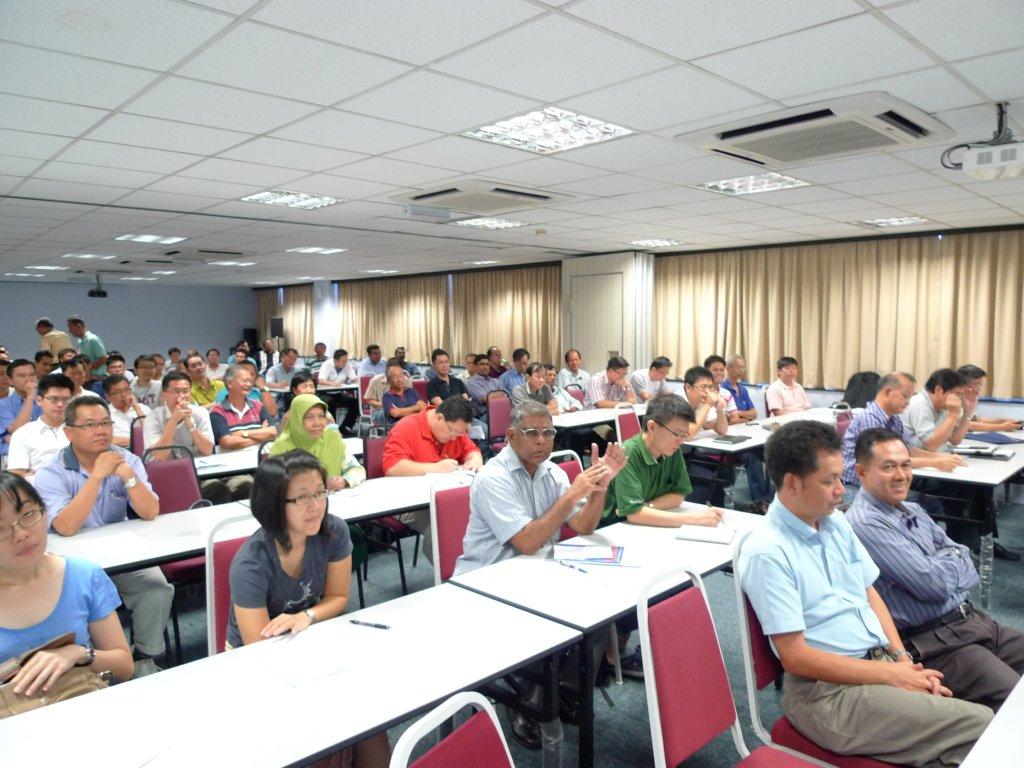
Technical talk by Prof. Dr. Hamzah Abdul Rahman, Deputy Vice Chancellor (Research and Innovation) of Univeristi Malaya has been carried out on 2 July 2011 (Saturday). The event later was followed by PMTD Annual General Meeting which seen current and new faces of Committee Member been elected. There were about 100+ attended both Technical Talk and AGM events.


Chairman (Ir. BC Lee) and Vice Chairman (Ir. Faizal Abdullah Sanusi)

Participants during technical talk and AGM

Ir. Noor Iziddin Abdullah B. Ghazali

Ir. Hj. Zainal Arsad bin Md. Amin

Technical Talk : Findings and Implications of a Survey on Project Management Best Practices In Malaysia (29 Jan 2011)

Report by Ir.Tan Ban Loong

Synopsis
The Project Management Technical Division (PMTD) of the Institution of Engineers, Malaysia had organised the above talk on 29th January 2011 at Wisma IEM. The talk was attended by 72 participants.

The talk was delivered by Ir. Frankie Chong (BSc, MBA, MIEM, PE, PMP®), past Chairman and Advisor of Project Management Technical Division, IEM. He is currently a Project Management Consultant, founder and Principal Consultant of ASK Consulting and an active professional speaker in Project Management.

Ir. Frankie Chong carried out a simple survey on project management best practices in Malaysia over a period of 2 years in 2006-2008 and found some interesting results and implications which will be useful to Project Management stakeholders, policy makers and practitioners who are looking for some quick answers to decision makings related to project management.

Simple objective type questions on project management best practices were given to multiple groups of project management workshop participants mainly consisting of practicing project personnel, IEM member engineers, architects, QS, consultants, housing developers and some business people. Altogether, about 200 respondents answered 17 key questions related to PM Standards & Methodology, certification, current practices and procedures, software usage, success and failure factors, contracts, etc., the results of which are interpreted and extrapolated in this talk.

Definition Of Best Practices:
The shortest distance between concept and completion.

Summary Of Survey Findings:
1.       The majority of respondents:
·         Are in support of a formalized and regulated PM environment (78%)
·         Achieve overall success rate of <60%. Keeping customers satisfied scores the lowest %.
·         Practices ad-hoc Project Management (58%)
·         Are in favor of a national Project Management Standard (83%)
·         Would like the Project Manager to be a certified professional (88%)
·         Feels that training in Project Management is essential, especially in soft skills (88%)
·         Believes that a structured PM methodology (90%) can determine the success rate of projects. Others include software (83%), ISO 9000 (84%), TQM (84%), templates (86%).
·         Use Microsoft Project software (66%). 19% never use any software!
·         50% of Project sponsors do not get involved widely.
·         Biggest constraint is time, followed by cost, customer, scope in that order.

2.       The least used PM practices are:
·         Value Engineering
·         Critical Chain
·         Stakeholder Analysis
·         Risk Management Plan
·         Variance Analysis
·         Earned Value Analysis
·         PERT Analysis
·         Monte Carlo Simulation
·         Change Control Board
·         TQM
Conclusion and Recommendations of Survey
·         Project Management best practices in Malaysia in general are still at Maturity Level 1-2 or introduction stage.
·         Success rate of projects can be improved by using a customised methodology in line with a recognised PM Standard.
·         There should be more focus on improving Soft Skills in managing people.
·         Encourage more relevant PM training and certification of project managers in line with the trend in globalization.
·         Many support implementation of a national PM Standard, but not sure whose job it is to develop one?
·         This survey is not conclusive. Further research by sector and industry is needed.

During the Q&A session, Ir. Frankie Chong answered all of the questions raised by the participants. He also carried out a survey on the spot with only 4 participants showing hands that have practiced Critical Path Analysis (CPA) and 3 have Project Manager Office (PMO) in their workplace. This reflected the infancy stage of Project Management practices in this country.

The writer then presented a certification of appreciation to the distinguished speaker. Readers may wish to read further materials at PMTD web site http://iem-pmtd.blogspot.com or join the interest group at  www.facebook.com/IEM.PMTD, or email to the speaker at  frankie2020@gmail.com for any enquiry.

The seminar ended at 11.30 a.m. according to the allotted time, practicing one of the best practices of Project Management on timely delivery.

Friday, May 6, 2011

Technical Talk : Naval Weapons System Project Management and Engineering Challenges (19 Oct 2010)

Talk on “Naval Systems Project Management and Engineering Challenges”
By Ir. Mustaffa Bin Tek

A talk entitled “Naval Systems Project Management and Engineering Challenges” was organized by the Project Management Technical Division (PMTD) on the 19 October 2010 at the C & S Lecture Room,Wisma IEM. The talk was delivered by Ltd Cdr Ir. Ahmad Mazlan Hj Zahari (Rtd) ,MIEM,P.Eng,CEng,FIMarEST and chaired by Ir.Lee Boon Chong (Chairman of PMTD). A total of 35 participants attended the talk.


Picture 1.  Ir. Lee Boon Chong and the Speaker

The main scope of the talk  as mentioned by the speaker was about the Naval Weapons, EngineeringPrinciples, Project Management and Maintenance Doctrine.
In a naval ship he pointed out that the major components are the sensors which are the eyes of the ship, the weapons installed on board the ship, the processing power and lastly the communication system.

On the weapons systems, the components he mentioned were the detection system i.e. the radar(radio detection and ranging) delivery   or tracking system and processing power system.
Ir.Ahmad Mazlan continued with the statement on ‘How Naval Weapon came into existence’ and the historical background of ships being fitted with canons in conquest of territory. He also described how the small vessels are able to demobilize the big ships with the technical innovation and invention by engineers.As time passes,sensors,weapons,processing power /competency and communications are the technical evolutions undertaken by the engineers.

The speaker continued the talk which also centered on the following areas:-
Sensors-Radar System, Contact, Identification Friend or Foe, Gyro System, Combat Management System, Types of Missile Guidance, Exocet Missles, CIWS, Falkland War Strategy, Purchasing Challenges, Competitive Price, Export Restrictions ,Long Term Sustainability, Maintenance &Defense Policy, Technical Issues and the Challenges.

The speaker also stressed that an engineer’s role is of the utmost importance in the operation and maintenance of a naval ships.Due to the complexity  and the high cost of operation and building a naval ship, countries like the United  States of America insist that the Captain of a naval ship must possess a degree in engineering in line with the advancement of technological innovations.

The Speaker also elaborated on the surface contacts, automatic identification system. This encompass the ship particulars which  will transmit a coded signal,an interrogated process, decoded and then re-transmit to determine a friendly or a hostile vessel.

On the importance of the threat assessment, the Identification Friend or Foe (IFF), the speaker quoted the case of the Iranian Airways due to the malfunctioning of the IFF, the US war vessel in the vicinity of the war zones fired a missile that blew up the aircraft and 135 people were killed.

On the Long Term Sustainability policy,a warship may cost from RM 750 million to 1 Billion and 50 -60 % cost is meant for the weapons and the sensors. Also the ship need to be maintained for a period of 25 to 30 years and thus the amount of money involved is exorbitant.

On the Maintenance and Defense Policy the speaker pointed out the various level of maintenance such as for Level 1 is onboard servicing, for Level 2 is the line card replacement, for Level 3 is the component replacement and forLevel 4 is the component overhaul and calibration. However the above maintenance process has to go back to the Original Equipment Manufacturer (OEM),thus monopoly is still the game of the day.

Lastly the speaker showed the look of the future naval ships which are powered by electric motors, thus the existence of compression engines will be the glory of the past. Also the future war of the sea shall use the tactical data network through advancement in ICT.

The session on Q &A was conducted before the closure of the talk by Ir.Iziddin Bin Abdullah  Ghazali,the PMTD committee member.

Finally in appreciation a momento from IEM was presented to the speaker by Ir. Noor Iziddin Abdullah bin Ghazali.

 Picture 2.  The participants during the talk

Technical Talk : Project Management & Six Sigma - New Approach (8 Sept 2010)

By Ir. Noor Iziddin Abdullah B. Haji Ghazali, PMP®, MIEM, P. Eng.
Committee of Project Management Technical Division for Session 2010/2011.

Project Management Technical Division (PMTD) of IEM organized a 2 hour talk entitled
“Project Management & Six Sigma” on 18 September 2010, at Auditorium in Wisma IEM,
Petaling Jaya. This talk was conducted in collaboration with Genaxis Sdn. Bhd; currently the
first and only American Society For Quality (ASQ) Certified Partner in Malaysia. The talk was
delivered by Mr. Selveentharan Muniandy, Chief Operating Officer (COO) from Genaxis Sdn.
Bhd. He is the professional member of the American Institute of Industrial Engineers and a
Registered Graduate Engineer in Malaysia's Board of Engineers. He holds a Bachelors Degree
(Hons) in Business Information System and is a Certified ASQ Master Black Belt Instructor,
Six Sigma Black Belt from General Electrics USA and Starwood Hotels & Resorts Worldwide
Inc. Mr. Selveen has also conducted 2 sessions of 2 days talk on 'Project Management & Six
Sigma" in IEM last year.

The primary objective of the talk was to introduce to the talk participants of using the
combination tools of Project Management and Six Sigma which can play a significant
role in the engineering environment. Project Management is a strategy applied in planning,
organizing and managing projects to ensure the success of completion within project goals
and objectives. On the other hand, Six Sigma is a statistical based process improvement
methodology and risk management tool that helps in minimizing errors and risk,
reducing costs, improving workflow and increasing customer satisfaction.

Six Sigma at many organizations simply means a measure of quality that strives for near
perfection. But the statistical implications of a Six Sigma program go well beyond the
qualitative eradication of customer perceptible defects. It is a methodology that is well
rooted in mathematics and statistics.

The objective of Six Sigma Quality is to reduce process output variation so that ±six standard
deviations lie between the mean and the nearest specification limit. This will allow no more
than 3.4 defect Parts per Million (PPM) opportunities, also known as Defects per Million
Opportunities (DPMO), to be produced.

By implementing Six Sigma wisely on carefully selected projects, companies will benefit
from:

•Improved customer satisfaction
•Reduced cycle times
•Increased productivity
•Improved process flow, capacity and output
•Reduction in total defects
•Increased product reliability
•Decreased work-in-process (WIP)

Brief explanation on Six Sigma Green Belt and Black Belt:-

Black Belt (BB) - Black Belts are the heart and soul of the Six Sigma quality initiative. Their
main purpose is to lead quality projects and work full time until they are complete. Black
Belts can typically complete four to six projects per year with savings of approximately
$230,000 per project. Black Belts also coach Green Belts on their projects, and while
coaching may seem innocuous, it can require a significant amount of time and energy.

Green Belt (GB) - Green Belts are employees trained in Six Sigma who spend a portion of
their time completing projects, but maintain their regular work role and responsibilities.
Depending on their workload, they can spend anywhere from 10% to 50% of their time on
their project(s). As the Six Sigma quality program evolves, employees will begin to include
the Six Sigma methodology in their daily activities and it will no longer become a percentage
of their time—it will be the way their work is accomplished 100% of the time. Now we know
how some companies have organizationally structured their Six Sigma quality program. But
how do you ensure that everyone’s doing their job? How do you we keep your our
employees motivated when fires are burning all over the corporate landscape?

This was the third time IEM organized such kind of Project Management & Six Sigma talk. A
total of 86 participants from various industries attended the talk. They consisted of both
corporate members and graduate members of IEM. After completing the talk, each of them
earned 2 PDUs of BEM Approved CPD/PDP Hours. Mr. Selveentharan Muniandy received a
certificate of attendance and a memento, from Ir. Noor Iziddin Abdullah B. Haji Ghazali, who
currently serves as a Committee Member of PMTD, at the end of the talk. Feedback from
the talk participants was encouraging with some indicating their intention to go for Six
Sigma Green Belt and Black Belt certification.

It is hoped that more engineers willparticipate in this talk to enhance their professional knowledge as well as professional career. First Admiral Dato’ Ir. Haji Ahmad Murad Omar (Rtd), who currently serves as the Advisor of PMTD chaired the talk’s opening and Ir. Noor Iziddin Abdullah B. Haji Ghazali, chaired the talk closing.